
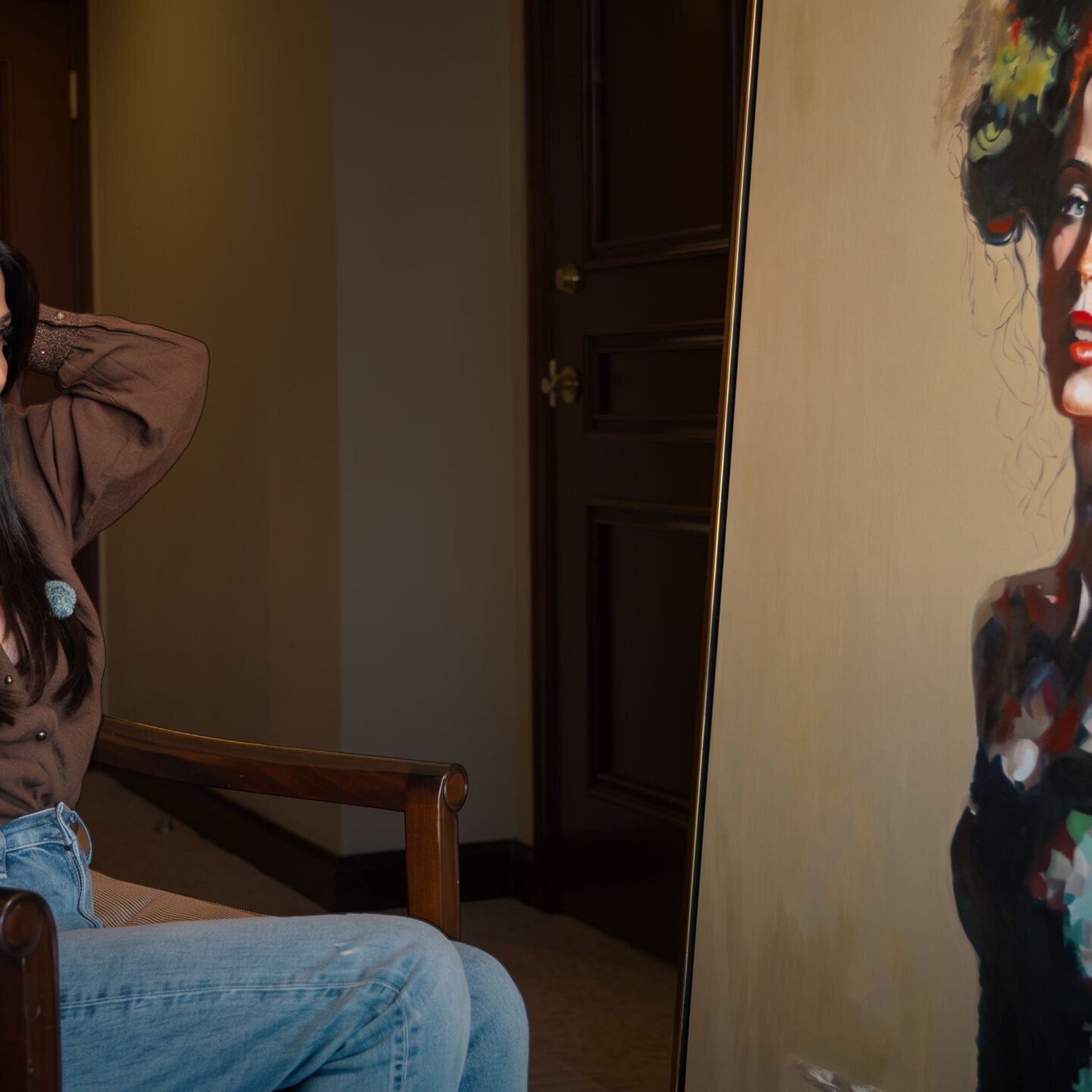

What happens when a painting transforms a familiar face into a deeply personal story of love, loss, and memory?For actress Marisol Nichols, the answer came during a private visit to the studio of Italian contemporary artist Alex Righetto, where she encountered Mona Lisa’s Daughter, an oil painting completed in 2023.
Known to international audiences for her portrayal of Hermione Lodge in the television series Riverdale and as Special Agent Nadia Yassir in the action drama 24, Marisol Nichols has spent much of her career bringing complex characters to life on screen. But during her visit to Righetto’s studio, she found herself on the other side of a story: standing before a painted face whose meaning reached far beyond its visual appearance.
As she contemplated the work and listened to the story behind it, Nichols struggled to articulate her response.
“It’s vibrating, it’s speaking, it’s living.”
To understand why this painting made such an impression, it helps to know the story that inspired it.
The Story Behind Mona Lisa’s Daughter
Completed in 2023, Mona Lisa’s Daughter is an oil painting by Alex Righetto dedicated to the daughter Lisa del Giocondo lost in 1499.
Lisa del Giocondo, traditionally identified as the woman in Leonardo da Vinci’s Mona Lisa, had five children with her husband, Francesco. Through this painting, Righetto focuses on Lisa not only as the face of one of the world’s most famous paintings, but also as a mother who experienced the loss of a child.
When actress Marisol Nichols visited Righetto’s studio and saw the painting in person, she was deeply moved.
“It’s vibrating, it’s speaking, it’s living,” she said.
Learning the story behind the painting made the experience even more personal.
“I feel like I know her,” Nichols said.
The story helped her connect with the woman portrayed on the canvas. She was no longer looking at a face from the past. She was thinking about a mother, her daughter, and the loss that connected them.
That connection moved Nichols emotionally and changed the way she experienced the painting.
The Power of Seeing the Painting in Person
Nichols had already seen images of Righetto’s work before visiting his studio. She knew what the paintings looked like on a screen. But seeing the original was an entirely different experience.
“It’s stunning online,” she explained. “But in person is a whole…”
She paused, searching for the right words.
Then she described what she perceived in the physical presence of the painting.
Her reaction speaks to something that reproductions cannot entirely capture.
A photograph can show the composition, the colors, and the subject. It can reveal the artist’s choices and give the viewer an impression of the finished work. But standing before an original painting is a different kind of encounter.
The physical scale, the surface, the details that emerge through sustained observation, and the relationship between the work and the viewer all contribute to the experience.
In the case of Mona Lisa’s Daughter, these elements meet with the emotional weight of the story behind the image.
Mona Lisa’s Daughter is a tribute to life and the duality it represents, but above all, to the human experience of living a spiritual life in a material world.
Here, immortality, represented by success, fame, and the iconic image of the Mona Lisa, conceals the weight of mortality to which we are all subject
This article was last updated on October 23, 2026 by Alex Righetto
This article available in: