


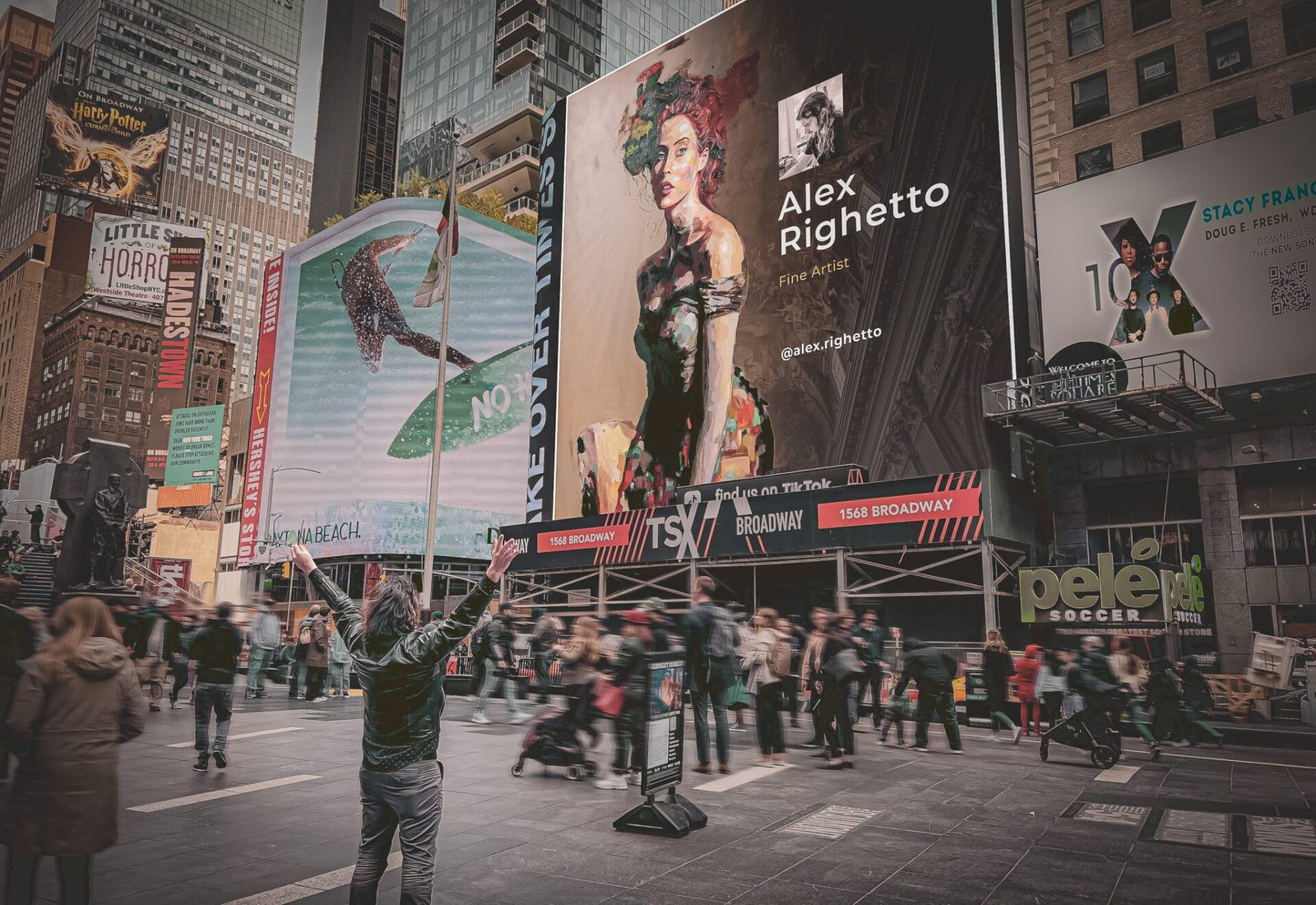
From April 23 to 29, 2023, Mona Lisa’s Daughter, a painting by Alex Righetto, was displayed on two monumental digital screens in Times Square, New York, one of them spanning more than 30 meters in width.
For an entire week, the painting appeared every few minutes, day and night, reaching an estimated audience of more than 2.5 million people. An artwork born from a personal artistic vision had found its place in the heart of one of the world’s most recognizable urban landscapes, marking a significant milestone in Righetto’s career.
Yet behind this monumental display lies a deeply human story, one that connects the Renaissance, the fragility of life, and the extraordinary power of art to make a person immortal.
Yet to understand the significance of this moment, it is worth returning to the origins of the painting and the imaginative question that inspired it.
The Story Behind Mona Lisa’s Daughter
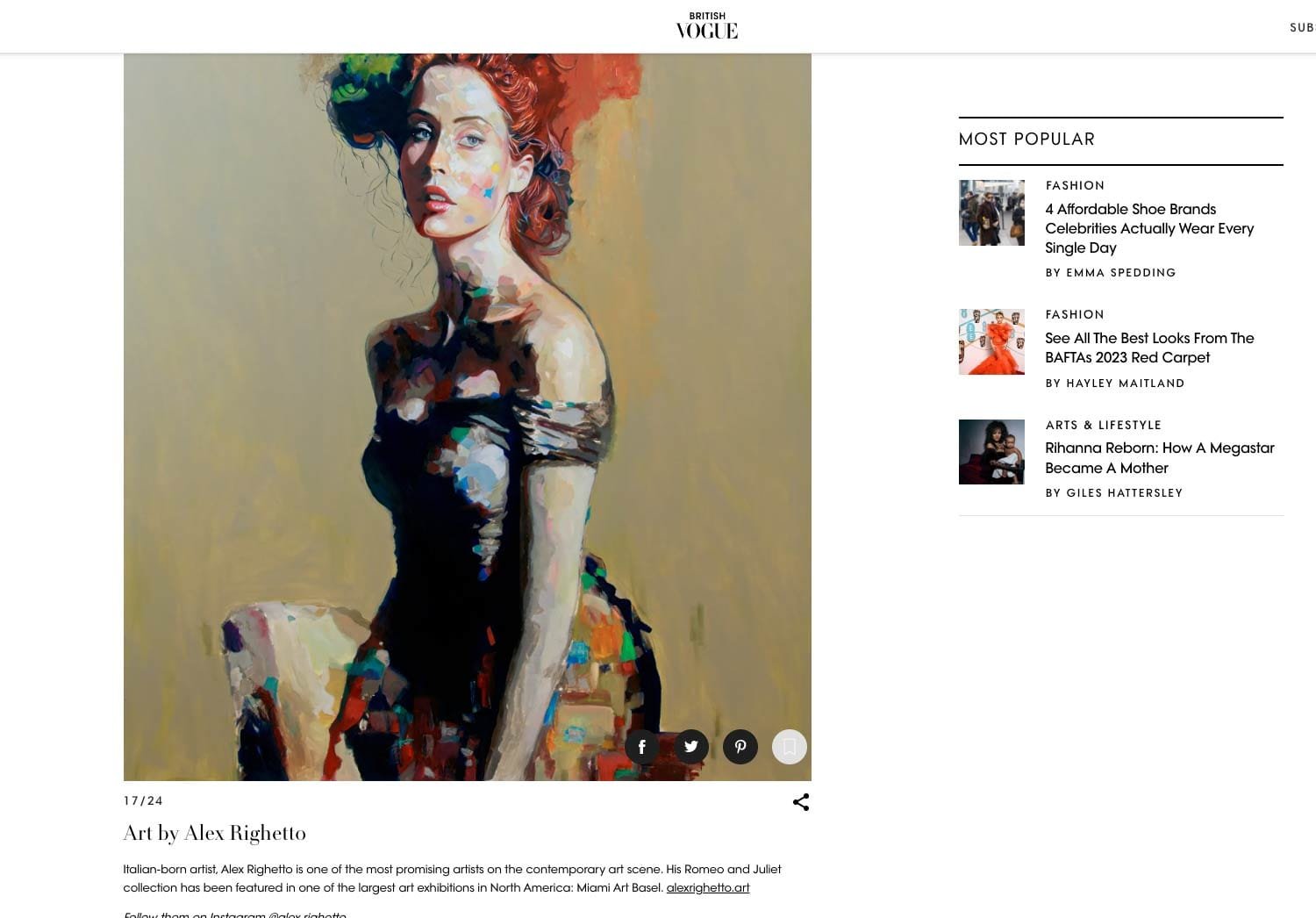
Created in 2023, Mona Lisa’s Daughter was inspired by Alex Righetto’s profound admiration for the Italian Renaissance and his desire to pay tribute to one of the most extraordinary periods in the history of art.
The starting point was a poignant detail in the life of Lisa del Giocondo, the woman immortalized by Leonardo da Vinci in the Mona Lisa: her daughter was stillborn.
This tragic event inspired Righetto to imagine the daughter who never had the opportunity to experience life. What would she have looked like? What might her story have been? And what does it mean to exist in the shadow of someone who has achieved immortality through art?
These questions became the foundation of a painting that goes beyond a simple homage to Leonardo’s masterpiece. Righetto created an entirely new image, giving an imagined face to a life that ended before it could begin.
At the heart of the work lies a striking contrast. Lisa del Giocondo has become one of the most recognizable women in human history, her image preserved for centuries at the Louvre and seen by millions of people from around the world. Her daughter, by contrast, never had the chance to live.
One became immortal through art. The other never experienced life.
This is the paradox that gives Mona Lisa’s Daughter its emotional and philosophical depth.
Yin and Yang: Immortality and Mortality
The central concept behind Mona Lisa’s Daughter draws on the ancient philosophy of Yin and Yang, which describes how seemingly opposite forces coexist and complement one another.
In Righetto’s painting, these opposing forces take the form of two radically different destinies: a mother whose image will endure for centuries and a daughter who never had the opportunity to experience the world.
Immortality and mortality. Presence and absence. Life and death.
The two figures are connected through a shared story, yet their destinies could hardly be more different. One continues to live in the collective imagination, while the other survives only through the story we choose to tell about her.
This contrast is also reflected in the painting’s visual language. Some areas are rendered with precision and definition, while others dissolve into gray, unfinished passages. The tension between these different treatments reinforces the relationship between what remains and what disappears, what is preserved and what is lost.
The result is an image in which beauty and decay, completeness and imperfection, coexist within the same composition.
Through this visual and philosophical dialogue, Righetto explores a universal question: what allows one life to be remembered while another fades into obscurity?
Art offers one possible answer. It has the power to preserve an image long after the person represented has disappeared. Yet it can also give visibility to stories that history has left untold.
With Mona Lisa’s Daughter, Righetto brings these two possibilities together, creating an imagined encounter between a woman the world will never forget and a daughter who might otherwise have remained unknown.


An Unexpected Encounter in Times Square
For many people passing through Times Square, encountering Mona Lisa’s Daughter was an unexpected experience.
Some stopped to look at the painting, others took photographs or asked questions about the artwork. The image appeared before tourists, residents, and visitors from around the world, many of whom had never encountered Alex Righetto’s work before.
Mona Lisa’s Daughter was created to reach audiences around the world and gain recognition in some of the most renowned publications. Its appearance on two monumental digital billboards in Times Square marked a major milestone in that journey.
Seeing Mona Lisa’s Daughter on two monumental screens in Times Square was a milestone in Alex Righetto’s artistic journey, bringing a deeply personal work inspired by the story of Lisa del Giocondo and her daughter to millions of people in the heart of New York.
This article was last updated on November 1, 2026 by Alex Righetto
This article available in:
